

Views: 0 Author: Site Editor Publish Time: 2026-08-13 Origin: Site
Walk into any professional kitchen and you'll find ovens doing very different jobs. One station might be churning out trays of golden pastries every few minutes. Another might be gently poaching fish or steaming vegetables without drying them out. Both tasks rely on heat, but the equipment behind them couldn't be more different.
Choosing the right oven isn't just a matter of preference. It affects food quality, staff efficiency, and ultimately, your bottom line. For restaurant owners, bakery operators, and catering businesses, understanding the difference between convection and steam technology is the first step toward making a smart equipment investment.
This guide breaks down how each oven type works, where each one shines, and what factors should guide your decision when upgrading your kitchen's cooking line.
No single oven does everything well. Baking a flaky croissant and steaming a delicate fillet of salmon require opposite conditions—one needs dry, circulating heat, while the other needs moisture-rich, gentle cooking. Kitchens that try to force one appliance to handle both tasks often end up with inconsistent results, wasted ingredients, and frustrated chefs.
That's why most high-volume kitchens, from hotel banquet halls to busy bakeries, stock more than one oven type. Understanding what each technology does best helps you avoid costly mismatches between your menu and your equipment.
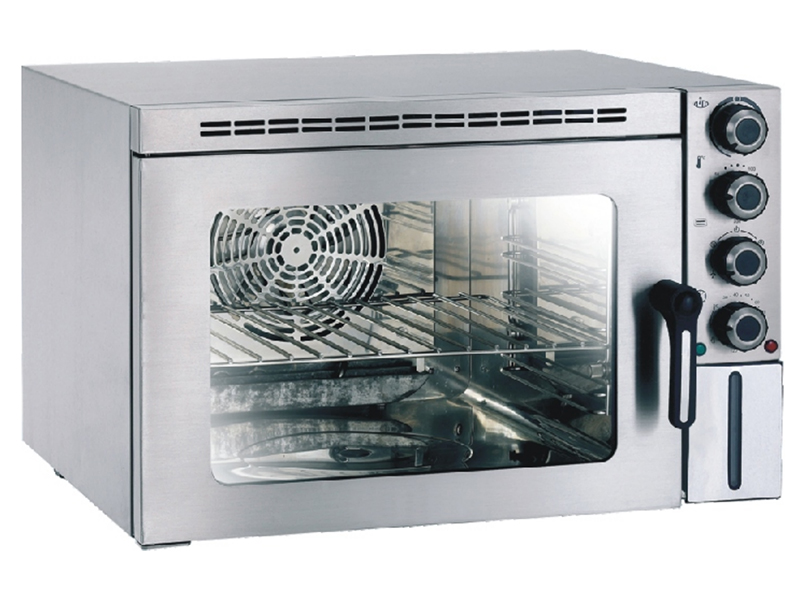
Convection ovens use built-in fans to circulate hot air evenly throughout the cooking chamber. This constant airflow eliminates the hot and cold spots common in traditional ovens, so every tray—whether on the top rack or the bottom—bakes at roughly the same rate.
This makes a convection commercial oven a natural fit for bakeries, pizzerias, and any kitchen producing large batches of baked goods. The moving air browns crusts evenly, shortens cooking times, and reduces the need for constant tray rotation. For operations where speed and consistency across dozens of trays matter, convection technology is hard to beat.
Steam ovens take a different approach entirely. Instead of circulating dry heat, they inject controlled moisture into the cooking chamber, cooking food gently while preserving texture, color, and nutrients. This makes them especially effective for proteins, vegetables, and delicate dishes that dry out or toughen under high, dry heat.
A commercial steam oven is commonly found in hotel kitchens, hospital food services, and fine dining establishments where menu items demand precision. Steam cooking also tends to retain more vitamins and minerals compared to dry-heat methods, which appeals to health-conscious menus and institutional caterers alike.
Feature | Convection Oven | Steam Oven |
|---|---|---|
Heat method | Circulating dry hot air | Moisture-based cooking |
Best for | Baking, roasting, pastries | Proteins, vegetables, delicate dishes |
Texture result | Crisp, browned exterior | Moist, tender interior |
Nutrient retention | Moderate | High |
Typical users | Bakeries, pizzerias, cafes | Hotels, hospitals, fine dining |
Cooking speed | Fast, even browning | Gentle, precise control |
As the table shows, neither oven type is universally "better." The right choice depends entirely on what's on your menu and how your kitchen operates day to day.
If your business revolves around high-volume baking—think bread, pastries, or pizza—a convection model will likely deliver faster turnaround and more consistent browning across every batch. Choose convection if speed, crust quality, and batch consistency matter more than moisture retention.
If your menu leans toward proteins, vegetables, or dishes where texture and nutrition are a selling point, a steam model is the stronger choice. Choose steam if you're serving health-focused menus, hospital patients, or dishes where overcooking is unacceptable.
Many larger operations eventually invest in both, dedicating stations to each cooking style rather than compromising on either.
Oven technology is only part of the equation. Build quality, insulation, and after-sales support matter just as much as whether you choose convection or steam. When evaluating a commercial oven for your kitchen, consider:
Capacity and footprint: Match the oven's size to your kitchen's volume and available space.
Build quality: Stainless steel construction and solid insulation hold up better under daily commercial use.
Energy efficiency: Lower energy consumption reduces long-term operating costs.
Manufacturer experience: Suppliers with a long manufacturing track record tend to offer more reliable, better-tested equipment.
Kaiping Kingpower Electrical Appliances Co., Ltd. has spent more than 18 years focused exclusively on oven manufacturing, producing both convection and steam models used across European commercial kitchens. That singular focus has shaped a manufacturing process built around consistency and durability, from tooling and sheet metal fabrication through final assembly and quality inspection. For operators who want equipment engineered to European standards without compromising on reliability, that depth of specialization carries real weight.
Convection and steam ovens solve different problems, and the best commercial kitchens often rely on both rather than forcing one appliance to do a job it wasn't designed for. Before purchasing, take a close look at your menu, your volume, and the dishes that define your business. That assessment will tell you far more than any spec sheet.
Whichever direction you choose, prioritize manufacturers with a proven track record in commercial-grade construction. Equipment built for daily, high-volume use will save you money and headaches over its lifespan.
Can one kitchen use both convection and steam ovens?
Yes. Many hotels, catering operations, and full-service restaurants run both oven types side by side, assigning each to the dishes it handles best.
Which oven type uses less energy?
Energy use varies by model and manufacturer, but steam ovens often cook at lower temperatures for shorter periods, which can reduce overall energy consumption for certain dishes.
Do convection ovens dry out food?
They can, if used for dishes that need moisture retention. That's why kitchens often pair convection ovens with steam equipment for a fuller range of menu options.
How long do commercial ovens typically last?
With proper maintenance, well-built commercial ovens from experienced manufacturers can last well over a decade, making construction quality and manufacturer reliability important purchasing factors.
